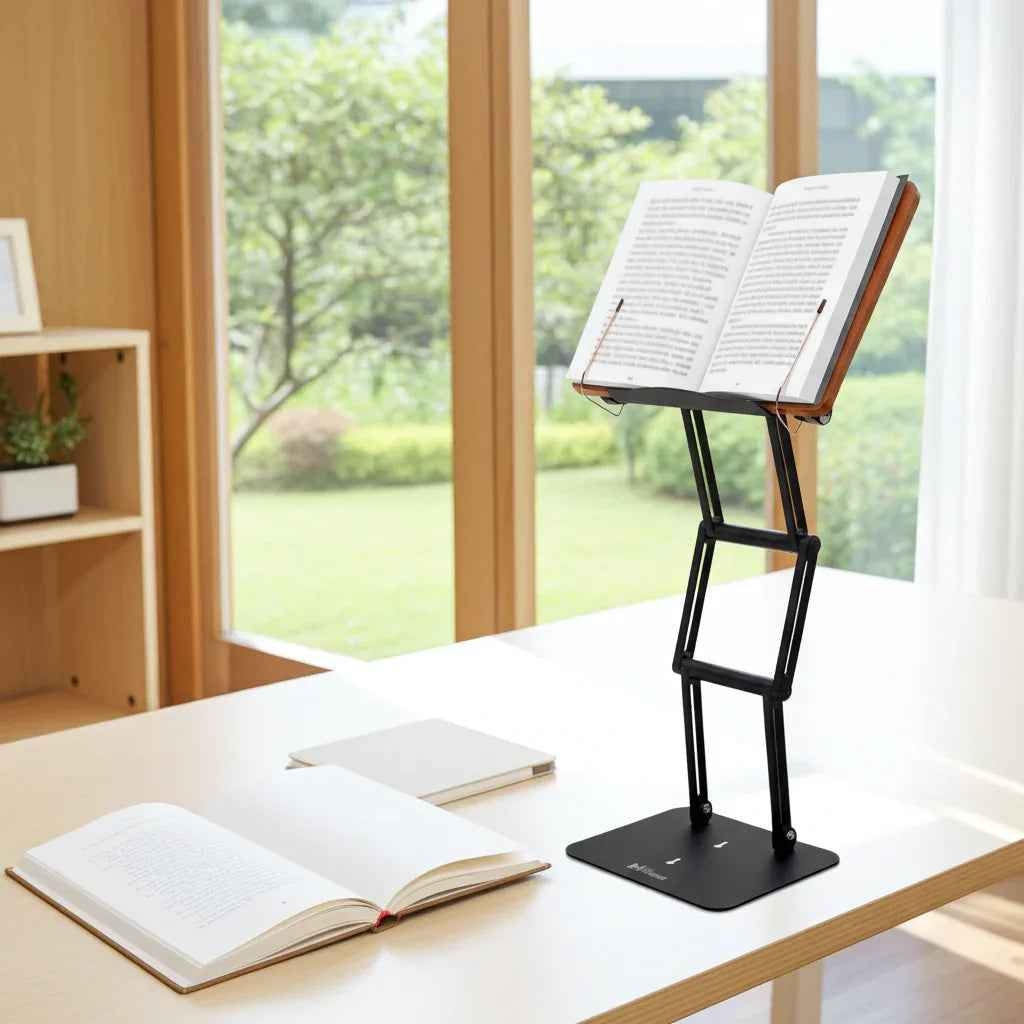
A heavy textbook should not force you into a collapsed posture. Yet that is what happens when a book lies flat on a desk: your eyes drop, your head follows, and your neck and upper back spend hours carrying the cost. The most meaningful heavy book stand benefits begin there. A properly engineered stand brings reading material upward, keeps it stable, and lets serious work happen without treating your cervical spine as an expendable resource.
This is not a small convenience for someone reading a few pages before bed. For students facing dense course loads, attorneys reviewing documents, researchers working through reference texts, and scholars studying sacred works, the reading surface is part of the work environment. If it is too low, too flimsy, or too limited in adjustment, it can make concentration harder than it needs to be.
Heavy Book Stand Benefits Start With Better Viewing Height
The human head is not designed to hover forward for long stretches. When you look down at a book, your neck bends and the muscles around the cervical spine must work to support that position. The farther forward the head drifts, the more effort those tissues must provide. That is why a long study session can leave a reader with neck tightness, shoulder fatigue, headaches, or the familiar urge to roll the shoulders every ten minutes.
A heavy book stand raises the page closer to eye level, reducing how far you need to bend your neck. It does not promise to fix every source of discomfort. Chair height, screen placement, movement habits, vision needs, and overall workstation setup still matter. But it removes one of the most obvious ergonomic problems: placing the material you need to see at the lowest possible point on the desk.
Height adjustment matters as much as elevation. A stand that only offers a shallow angle may help with a paperback, yet still leave a large textbook below a comfortable viewing line. A serious adjustable stand can raise the material enough for seated reading and, in some setups, moderate standing work. That flexibility makes it easier to change positions during a long day instead of remaining locked into one posture.
Stability Changes the Quality of the Work
A light stand can look acceptable until it meets a demanding assignment: a thick medical textbook, a large art book, a legal volume, a siddur, or a reference work that does not enjoy being balanced on a narrow plastic ledge. When the platform shifts, sags, or threatens to tip, the reader makes constant small corrections. That distraction adds up.
The practical value of a heavy-duty stand is simple: it holds its position. A stable base, durable joints, and a substantial support lip allow the user to turn pages, annotate, compare passages, or type alongside a displayed book without managing the stand every few minutes. The object disappears into the workflow, which is exactly what good equipment should do.
Weight is not automatically a virtue. A stand that is unnecessarily bulky may be inconvenient to move between rooms or pack for travel. The goal is useful mass and sound construction, not a desk accessory that feels like gym equipment. For a permanent study area, office, library, kitchen, or home workstation, a more substantial stand usually earns its footprint through better stability and higher load capacity.
Heavy Book Stand Benefits for Serious Texts
Large books create two separate problems: they are heavy, and they are physically awkward. Their pages may resist lying flat. Their spines can be stressed when opened too aggressively. Their dimensions may exceed the shallow shelves found on basic tablet stands.
A capable book stand supports the book from below while holding it at a workable angle. This can make dense reading less tiring because the text remains visible without flattening the volume against the desk. It also gives the reader a more natural place to rest a hand while taking notes or following a passage.
For religious and scholarly study, the idea has a long history. The traditional shtender was never merely decorative. It provided a raised, dedicated place for learning and prayer. A modern interpretation should preserve that seriousness while adding the ergonomic range and mechanical stability needed for contemporary books, laptops, and tablets.
A Clearer Desk Supports Clearer Thinking
The physical benefits of elevation are compelling, but the workspace benefits matter too. A large open book can consume most of a desk, leaving little room for a notebook, keyboard, writing pad, or second source. Raising the book creates usable space underneath and around it.
That matters when work requires comparison. A graduate student may need a source text open while writing notes. A professional may be reviewing a binder while working from a laptop. A musician may need sheet music visible without giving up the tabletop for an instrument accessory. A stand turns the book from desk clutter into an accessible vertical reference.
There is also a mental advantage to a designated reading position. When materials have a stable, intentional place, it is easier to begin. The desk feels prepared for work rather than assembled out of compromises. No, a book stand will not write the dissertation, finish the exam prep, or explain a difficult passage. It will, however, remove several small annoyances that make it easier to postpone starting.
One Platform, More Than One Use
The best heavy book stands are useful beyond books. Their stable platform and adjustable viewing height can support a laptop, tablet, cookbook, sheet music, or printed materials during a presentation. Some users even use one as a compact lectern or a holder for a small projector. That versatility matters because a well-built stand should not sit idle once one task ends.
There are trade-offs. A laptop placed high enough for better screen height may require an external keyboard and mouse to keep the arms and wrists in a comfortable working position. A tablet used for video calls may benefit from a different angle than a textbook used for reading. The answer is not one fixed setup. It is equipment that gives you enough adjustment to build the right setup for the task in front of you.
The Stander 1.1 is designed for that range of serious use. Its aluminum construction and stainless steel joints support demanding materials, while its adjustable design raises the supporting lip up to 17.8 inches above the tabletop. Since the book or screen sits above that lip, the actual viewing height is much higher, depending on the item being used. This creates meaningful options for seated and standing work, and everything in between.
Improve Your Setup
If you're looking to elevate your law books, tablets, or laptops to a more comfortable reading position, an adjustable stand can make a significant difference.
What to Look for Before You Buy
Do not judge a heavy book stand by appearance alone. A glossy product photo cannot tell you whether the platform wobbles under a textbook or whether the adjustment mechanism will hold after repeated use. Look closely at the materials, the joint design, the size of the support surface, and the stated capacity for larger books and devices.
The adjustment range deserves particular attention. Many stands tilt, but relatively few rise high enough to make a real difference for eye-level viewing. Also consider the base. It should feel secure on your intended surface without requiring a huge amount of desk space. Finally, think honestly about your heaviest and most frequent use case. If you regularly read substantial volumes, choose for that reality rather than for the occasional tablet session.
A good stand should encourage better habits without demanding a complicated ritual. Place the material at a height that lets your gaze stay more level, keep your shoulders relaxed, and take regular breaks to move. The objective is not to hold one perfect pose all day. It is to create a workspace that makes healthier movement and sustained focus more realistic.
Your books may be weighty because the work is weighty. They do not need to pull your posture down with them.